The Lump of Bronze: The Antikythera Mechanism and Its Counted Teeth
In 1901 a lump of corroded bronze came up from the Antikythera wreck. Inside was a machine that counted eclipses, and a forgotten tradition.
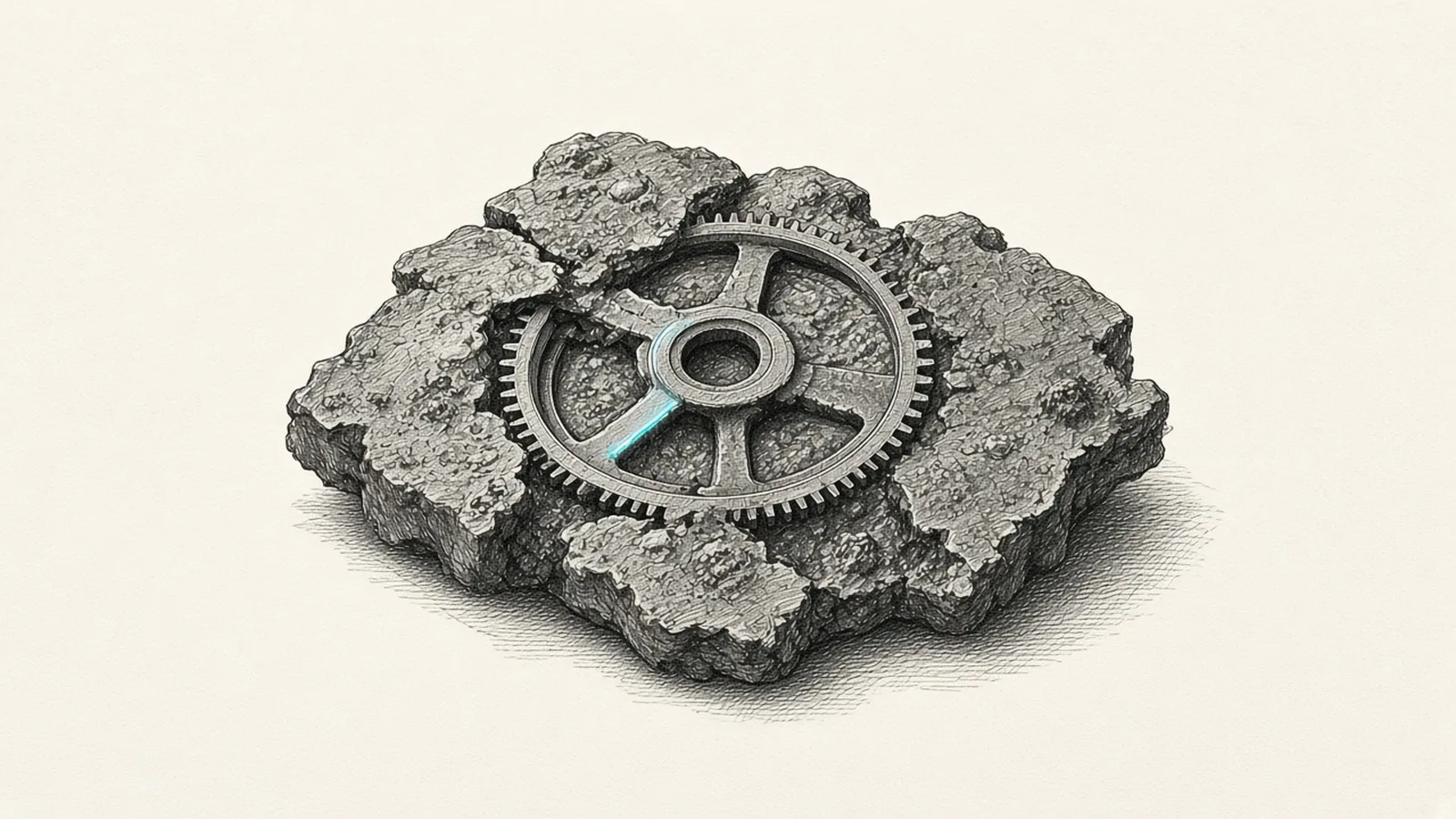
In early 1900 a crew of sponge divers from the island of Symi, led by Captain Dimitrios Kontos, found a wreck about forty-five metres down, off the Greek island of Antikythera. It was a Roman cargo ship. With the Hellenic Royal Navy, between 1900 and 1901, they brought up bronze and marble statues, pottery, glassware, jewellery, coins. And, probably in July 1901, a lump of corroded bronze inside the remains of a wooden case.
The lump ended up in the National Archaeological Museum in Athens. In 1902 a visiting politician, Spyridon Stais, noticed that it contained a gear wheel. It was the first hint that the green crust was not a broken statue but a machine.
Two hundred and twenty-three teeth
Today the block is divided into 82 fragments. The largest gear is about thirteen centimetres across and originally had 223 teeth. The number is not chance: 223 lunar months make up the Saros cycle, just over eighteen years, after which solar and lunar eclipses repeat. On the back of the machine a spiral divided into 223 cells marked, in 51 of them, 38 lunar and 27 solar eclipses. Another pointer followed the four-year cycle of athletic games.
It took half a century for anyone to look inside. The historian of science Derek de Solla Price took an interest from 1951; in 1971, with the physicist Charalampos Karakalos, he made X-ray and gamma-ray images of it, and in 1974 he published a study with a telling title, Gears from the Greeks. In 2005 a Cardiff University team led by Mike Edmunds used X-ray tomography: the scans suggest 35 meshing bronze gears, thirty still visible, and they read faint inscriptions on the casing. The back door carried something like an instruction manual, with the number 223 written out.
The dating is still debated, between 205 and 87 BC, but the machine is certainly older than the wreck, which went down around 70-60 BC. It is considered the oldest known analogue computer. Machines of similar complexity do not appear again in western Europe until the fourteenth century.
A machine that was not alone
The myth here touches a precise object: a case of bronze and wood that someone turned with a crank to see the sky of years they would not live. The point is not the marvel. Cicero writes of spheres built by Archimedes and by Posidonius, and those who reconstructed the mechanism agree it was too refined to be a one-off. So there were others, and a tradition of craftsmen who knew how to cut those teeth. Of that tradition no manual, no workshop, no certain name survives. The lump survives.
It is the figure described in When Technology Becomes Myth: a technical object becomes a story when its function stops being visible. And it resembles the eight-inch floppy, the other end of the same story: a medium that still carries its data while the knowledge to read it grows thin. A civilization does not lose its machines all at once. First it loses the hands that understand them, then the words to describe them. The machines remain, at the bottom of the sea, with their teeth counted.
Sources: Antikythera mechanism, Wikipedia (accessed 19 November 2026); D. J. de Solla Price, Gears from the Greeks. The Antikythera Mechanism: A Calendar Computer from ca. 80 B.C., Transactions of the American Philosophical Society 64 (7), 1974.
> ln -s ./linked-nodes
- [PART OF] Technological Mythology
- [RELATED] When Technology Becomes Myth
- [RELATED] The Eight-Inch Floppy: When a Living System Is Already a Ruin
- [REFERENCED BY] The Stud in the Ankle: Talos, the Bronze Guardian of Crete