An Exclamation Mark on Glass: Hubble and the VAR! Plate
In October 1923 Edwin Hubble crossed out an N on a plate of Andromeda and wrote VAR!: a Cepheid that carried the universe beyond the Milky Way.
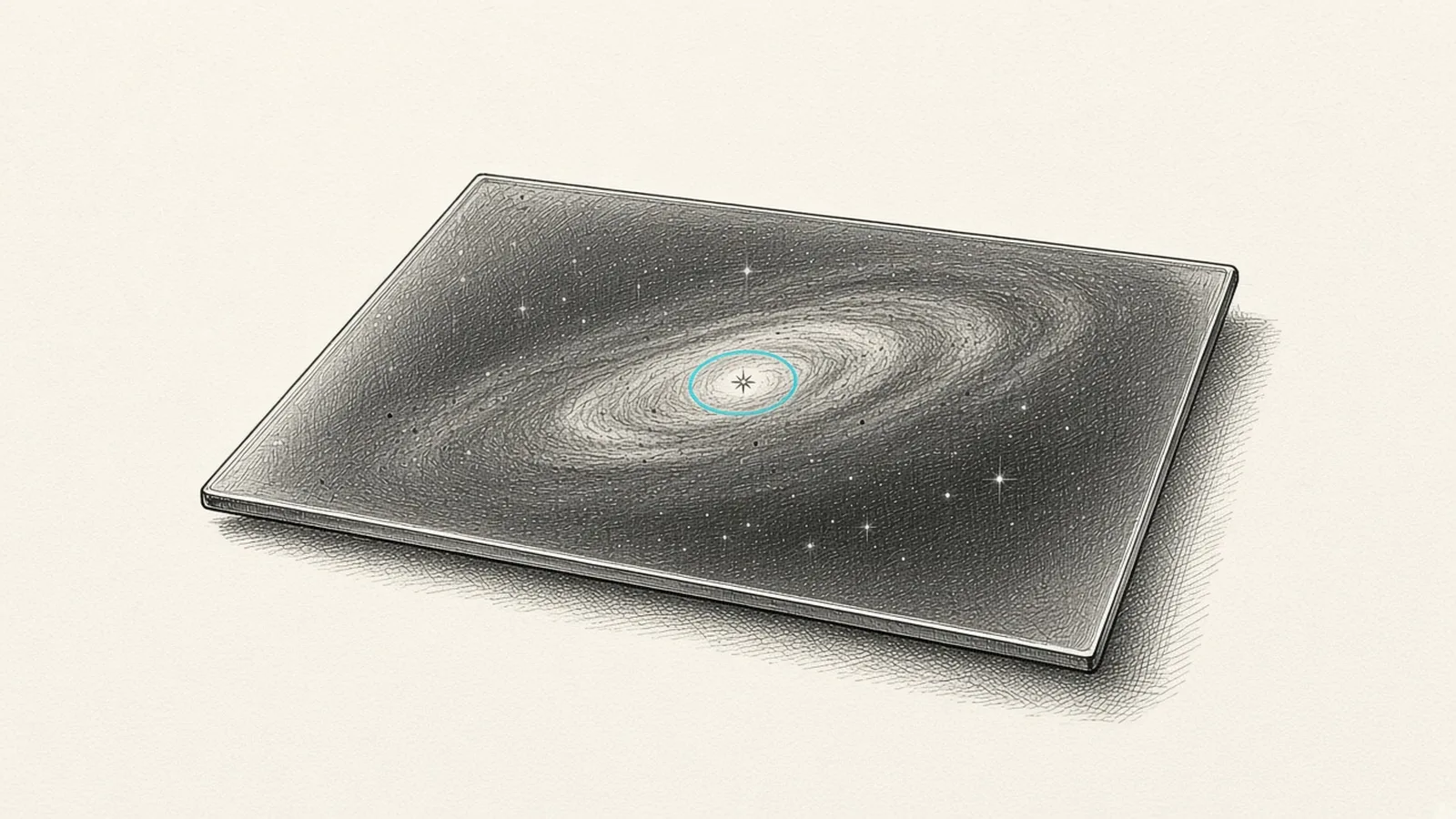
On the night of 5 to 6 October 1923, on Mount Wilson in California, Edwin Hubble pointed the 100-inch Hooker telescope at the great Andromeda nebula and left the shutter open for forty-five minutes. The result was a glass plate about four inches by five, with a photographic emulsion on one side. At the top, by hand, Hubble noted what one always notes: the plate number, H335H, the object, the length of the exposure, the quality of the sky, the hour.
Then he compared it with plates from earlier nights and looked for what had changed. He found three new points and next to each, on the glass side, he wrote a letter in ink: N, nova. A star that suddenly flares, an event.
The crossed-out letter
One of the three was not an event. Compared with other plates, its light did not explode: it rose and fell with a regular rhythm. Hubble struck a line through the N and wrote beside it, in capitals, VAR!, with the exclamation mark. It was a Cepheid variable, catalogued today as V1.
The exclamation mark is earned. A few years earlier Henrietta Swan Leavitt, at Harvard, had shown that the rhythm of these stars reveals how bright they really are, and therefore how far away: I wrote about it in Henrietta Leavitt's Rhythm. Finding a Cepheid in Andromeda meant being able to measure the distance to Andromeda. And distance was the whole question.
In 1920, in Washington, Harlow Shapley and Heber Curtis had argued about exactly this in public: whether the "spiral nebulae" were clouds inside our own galaxy or galaxies in their own right, other island universes. Curtis had already estimated, from novae, an enormous distance; others had objected. What was missing was a ruler that did not depend on an assumption. The Cepheid was that ruler.
A year of silence
The detail I like best is the delay. Hubble did not rush to publish. According to the Carnegie Institution, which keeps the plate, just over a year passed before the discovery was reported to the American Astronomical Society. Meanwhile he kept photographing, measuring, looking for more variables. An exclamation mark on glass was not enough: the rhythm had to come back.
The distance he derived was too small compared with the one accepted today, around two and a half million light-years. It did not matter. Even badly off, it was large enough to put Andromeda outside the Milky Way. The error was in the figure, not in the order of things.
This is where the object becomes larger than itself. A piece of glass the size of a hand, with three letters in ink, moved the border of what we call the universe from one galaxy to countless ones. The myth, if there is one, is not in the vastness that opens up. It is in the smallest gesture: a letter crossed out because the data no longer supported it, and another written in its place.
Anyone who works with measurements knows that line. The first label is almost always the event, because an event explains itself. The second, when it comes, is the rhythm: duller, more repeatable, and able to carry you much further.
Plate H335H is still in Pasadena, in the Carnegie archives. The crossed-out N can still be read.
Sources: Carnegie Science, Hubble's Famous M31 VAR! plate and The universe: Historical discoveries from Edwin Hubble and others; ESA/Hubble, Snapshots of the star that changed the Universe; Andromeda Galaxy, Wikipedia (accessed 23 November 2026).
> ln -s ./linked-nodes
- [PART OF] Cosmic Scale
- [RELATED] Henrietta Leavitt's Rhythm: the Stars That Measure Distance
- [RELATED] Thinking Against Cosmic Scale